
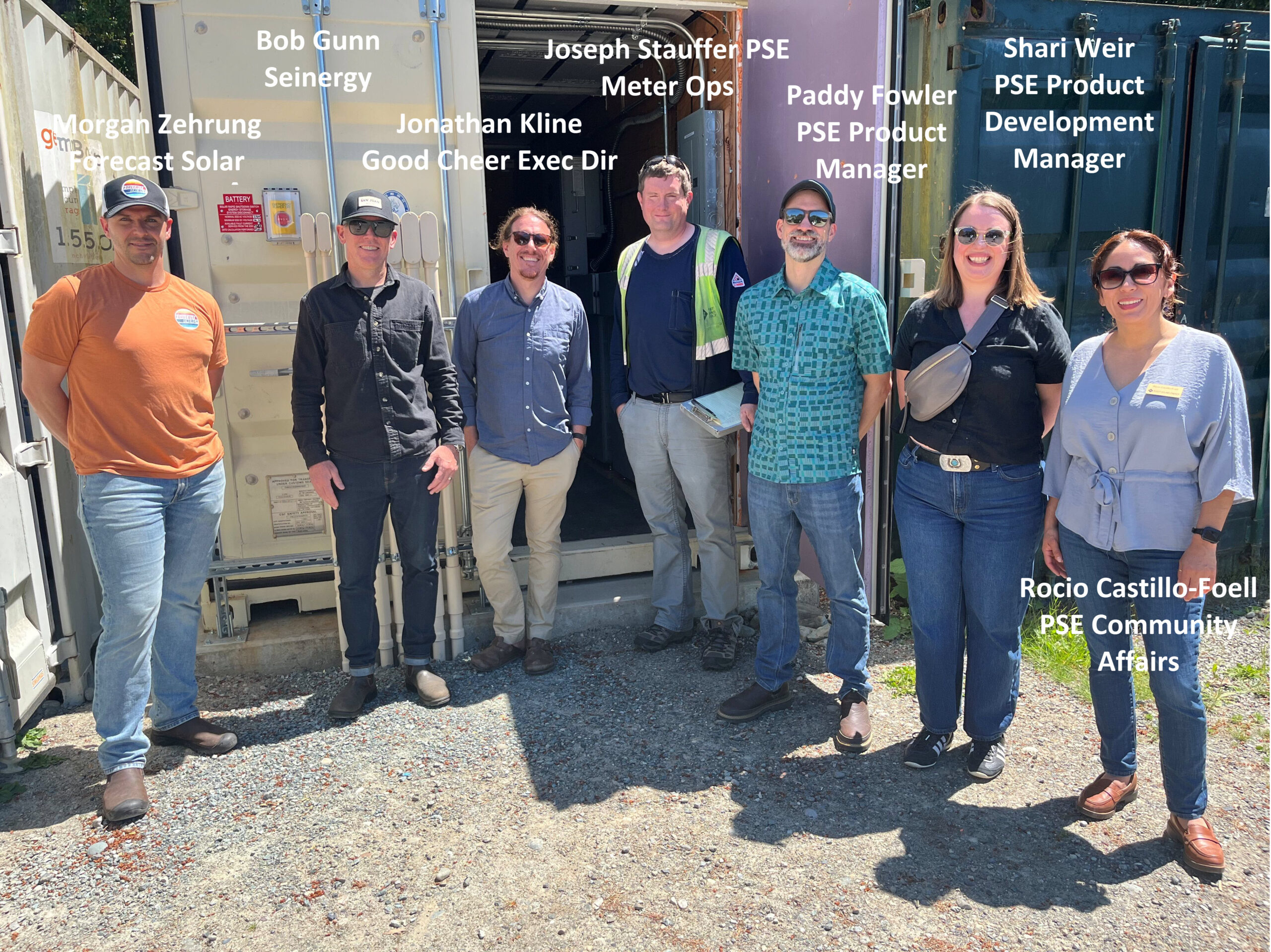
 This month marks a successful finale in a long partnership. We wrapped up a Solar + Storage project involving a handful of funding partners and contractors. Although this project took over three years to complete, doing it thoroughly was worth the wait. And now the rural community of South Whidbey Island has a non-profit site with proper solar and battery backups. This infrastructure will be used to power a cleaner operation with lower costs on a daily basis, as well protect food bank perishables during frequent power outages. A bonus is enhancing community resiliency – in an extended outage or emergency, Good Cheer can remain electrified, heated or cooled, and help anyone in need.
This project depended on a non-profit’s willingness to participate, an engaged electric utility, significant grant sources, creative strategy, persistence when things didn’t go as planned, and a managing actor connecting the dots and moving the project forward.
Project oversight
In early 2023, Seinergy’s founder, Bob Gunn, heard about new grant opportunities through the Washington State Climate Commitment Act via WA State Department of Commerce to bolster rural resilience through solar and battery backups. Seinergy was already accessing energy grants for the indoor agricultural sector. Living on Whidbey Island, WA, Bob knew that power outages were frequent and many people lost heat, bathrooms, and cell phone charging during an outage. Not to mention food spoilage. He reached out to a handful of entities that seemed like a good fit for the commerce grants. Good Cheer Food Bank said ‘yes’.
Good Cheer Food Bank
Good Cheer is a not-for-profit organization providing food, clothing and other services to residents in need on South Whidbey Island. They have a food bank serving nearly 400 households. During outages, they run a propane gas generator, but the propane reserve only lasts 70 hours when full, is expensive to operate, and food spoilage is a risk. Good Cheer’s ED and board were receptive to the project. However, they were clear that Good Cheer did not have the budget for a microgrid capital project. They were willing to lend some staff time, as necessary, but openly didn’t have in-house expertise or bandwidth to manage this scale of project.
Feasibility grants
With Good Cheer’s blessing, Seinergy applied and received a Commerce grant for a feasibility study. Seinergy managed the study, bringing in MZ Solar for technical support and system modeling. One year after initially engaging with Good Cheer, Seinergy and MZ Solar presented the preferred plan to Good Cheer. The goal was to have enough solar plus battery backup to power a modified facility for a 3-5 day outage, no matter the season. This would allow the food storage area to remain temperature-controlled, as well as a heated (or cooled) room for people to be comfortable and power devices, and to keep the water running throughout the building. The Good Cheer site also had components allowing it to be used as a hub during an emergency such as an earthquake.
Implementation grants
The feasibility study included cost estimates for implementation, as well as potential funding avenues to make it happen. The route to implementation depended on 40% grant funding from Commerce, 30% grants from Puget Sound Energy, and 30% covered by the Federal Government’s Investment Tax Credit Direct Pay program funding for organizations like Good Cheer.
On behalf of Good Cheer, Seinergy applied for, and received Phase 2 funding with WA Dept of commerce, which was awarded in 2025. Seinergy acted as owner’s rep and project manager for the implementation phase in order to reduce burden on Good Cheer employees. PSE generously stepped in to help address a significant funding gap. As part of the partnership, Good Cheer agreed to participate in piloting grid-stabilizing techniques.
Logistical & funding changes
Unfortunately, in 2025 the project’s federal funding disappeared due to national program cancellation. Good Cheer also experienced executive director turnovers and board changes. This put the project at risk for not getting completed.
Fortunately, a few things fell into place. Firstly, the cost of battery materials came down from the initial estimate. Secondly, the project was modified slightly to cut any unnecessary costs. Finally, the installers helped Good Cheer access preferential equipment pricing as a non-profit.
Final surprises
After much strategizing and analyzing, it looked like the project would move forward. However, once the project was under way, at the last minute, a new transformer was needed at the site, installed at the expense of Good Cheer. Again, Good Cheer did not budget for any capital outlay for this project and it looked like the whole thing would fall apart for an $8,000 expense. Bob and Seinergy dove deep into the numbers, updating the initial budget with actual information. Luckily, the team planned a 5% contingency budget to buffer the project for unknown circumstances. The contingency budget was just enough to fund the new transformer without having to fundraise or cut corners. Every dollar was accounted for!
A round of applause to Good Cheer, Puget Sound Energy, WA Department of Commerce, MZ Solar and the Climate Commitment Act for working with us to get this project across the finish line!


